Blox Fruits Map: Islands Locations And Level Requirements
Blox Fruits map islands locations and level requirements by sea, with island order, unlock levels, and clear advice on where to grind next.
Mar 15, 202612.3K Shares615K Views
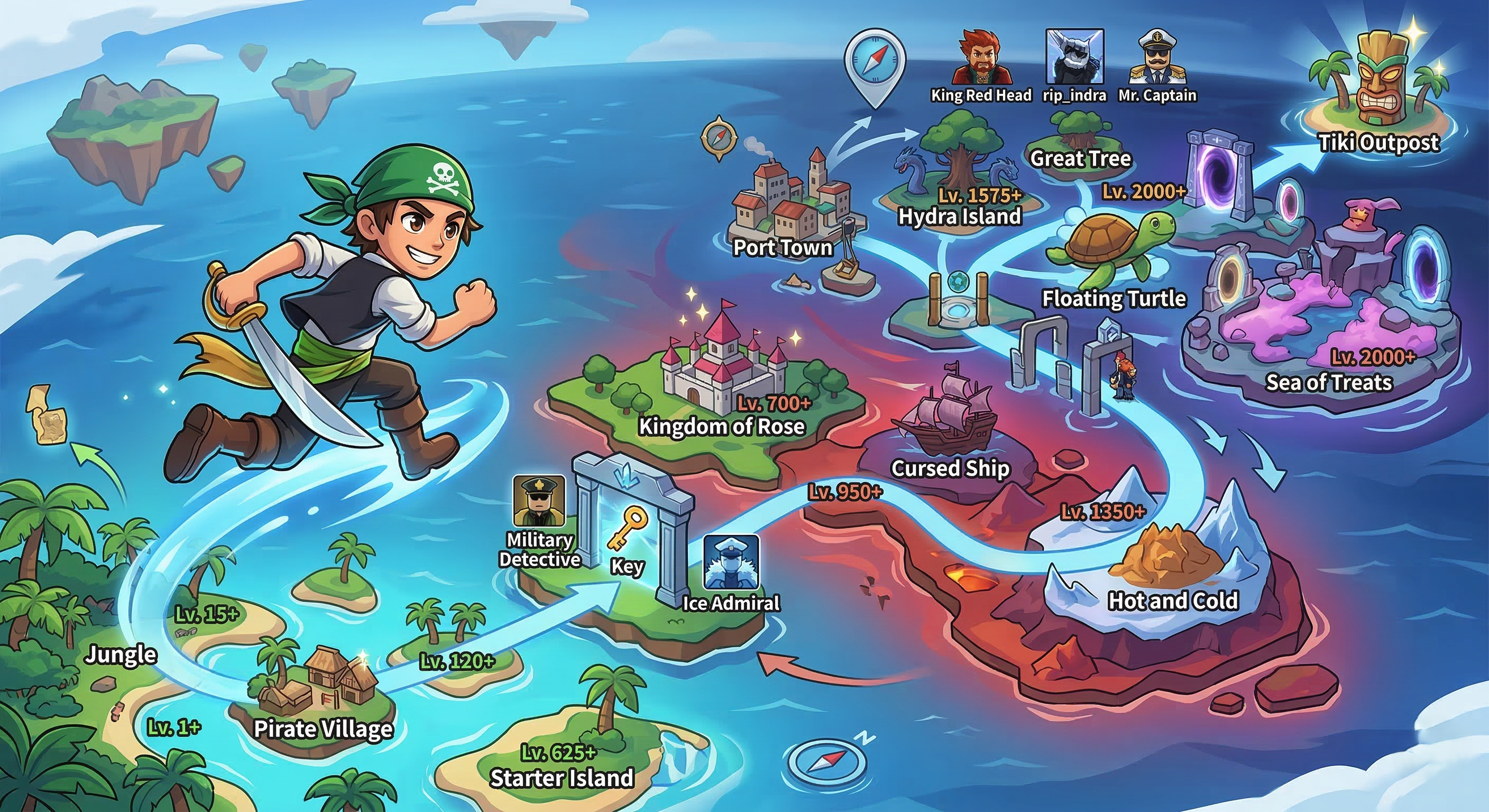
Blox Fruits Islands Locations And Level Requirements
Getting lost in Blox Fruitsusually is not a map problem. It is a progression problem. A lot of players land on the right island at the wrong time, rush into the next sea too early, or waste hours on a side location that looks important but is not part of the best leveling route.
What follows is a cleaner way to read the world:sea by sea, island by island, level by level. The goal is simple. When you finish reading, you should know where you are, what comes next, and when it actually makes sense to move on.
Key Takeaways
- Blox Fruits has three seas, and each one acts like a new stage of progression with its own island route.
- Second Sea unlocks at Level 700 after the Military Detective, Ice Admiral, and Experienced Captain steps.
- Third Sea unlocks at Level 1500 after the Colosseum questline involving King Red Head, rip_indra, and Mr. Captain.
- The smartest route is usually the highest island that still matches your quest range, not every island on the map.
- Some places, such as Middle Town, Café, and Castle on the Sea, matter a lot but are better treated as hubs than as core grinding islands.
How The Blox Fruits Map Is Structured
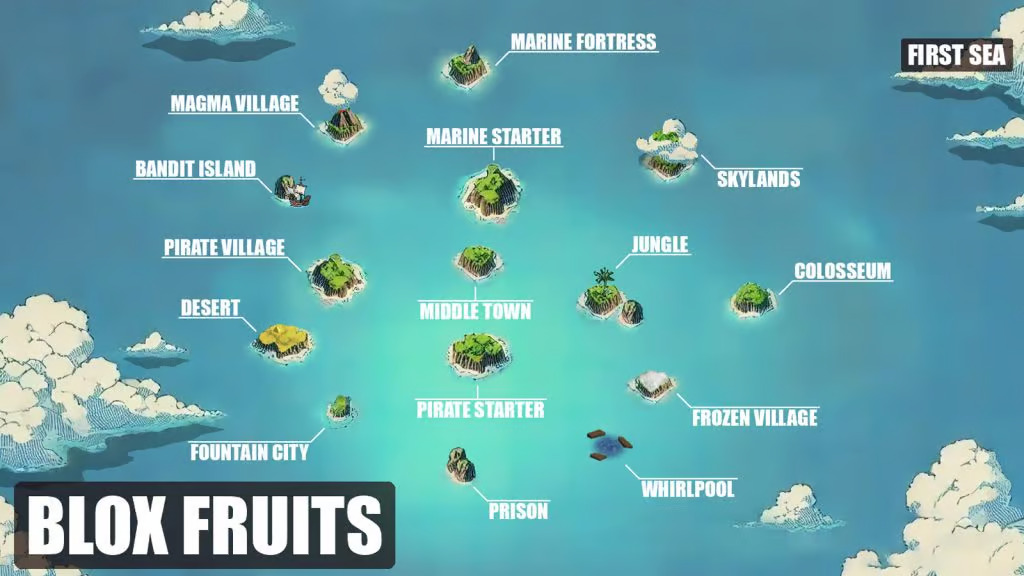
This section gives you the logic behind the map, so the later tables feel useful rather than random. Once you see how the seas work, the route becomes much easier to remember.
The Three Seas At A Glance
Blox Fruits is split into First Sea, Second Sea, and Third Sea. The current sea pages place their broad progression ranges at 1-700, 700-1500, and 1500+, respectively, which is the cleanest starting point for understanding the map as a whole.
What Level Requirements Really Mean
Level requirements tell you when an island becomes practical, not when it magically becomes the only possible place to stand.
A better way to think about them is this: an island is right for you when its quests, enemy spacing, and travel time still make your leveling efficient.
The community leveling route even recommends skipping or minimizing certain islands because they are awkward to grind, despite being available.
Main-route Islands Vs Side Hubs And Special Locations
This distinction is where many guides fail. Main-routeislandsare the stops that genuinely move your leveling forward.
Side hubs and special locations matter for travel, bosses, raids, or NPCs, but they are not always your next best grind spot.
That difference is obvious in the current sea lists, which separate the main islands from other locations in both the Second Sea and Third Sea.
The map makes more sense when you stop asking, What exists here? and start asking, What actually moves my account forward next?
First Sea Island Order And Level Requirements
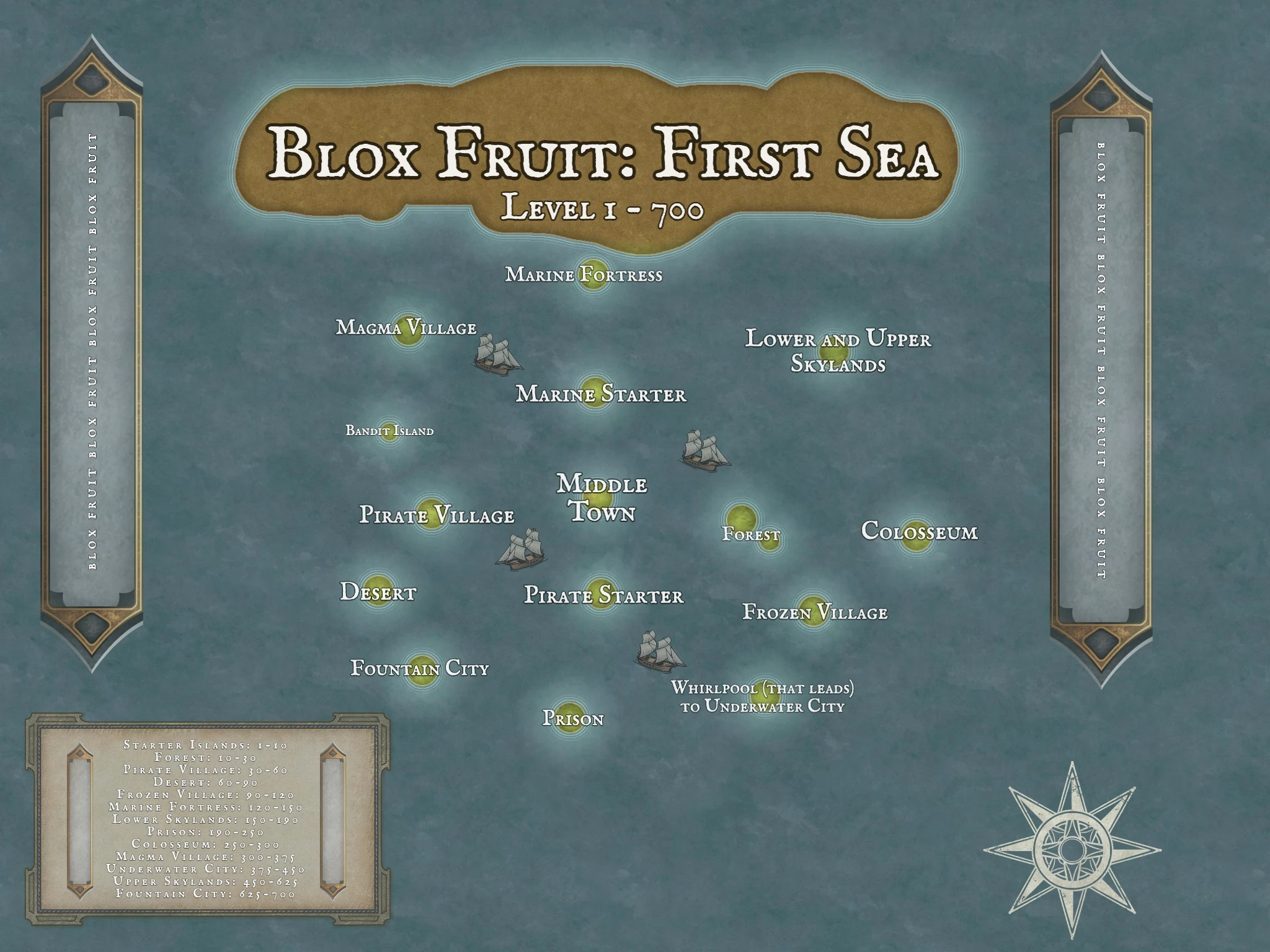
This is the sea where you build your route habits. The goal is not just to hit Level 700 fast, but to leave First Sea with a clean sense of where important unlocks and travel hubs are.
First Sea Quick-reference Table
The First Sea page lists the main islands, and the current First Sea map reference gives clear entry levels for the core route. Use this table as your practical path, not as a rule that forces you to visit every stop for the same amount of time.
Main Leveling Islands
| Island | Typical entry-level |
| Pirate Starter Island / Marine Starter Island | 1+ |
| Jungle | 15+ |
| Pirate Village | 30+ |
| Desert | 60+ |
| Frozen Village | 90+ |
| Marine Fortress | 120+ |
| Skylands | 150+ |
| Prison | 190+ |
| Colosseum | 250+ |
| Magma Village | 300+ |
| Underwater City | 375+ |
| Fountain City | 625+ |
Utility And Special Locations
| Location | Typical use |
| Middle Town | Travel hub, Experienced Captain, general convenience |
| Upper Skylands | Extension of Skylands content |
| Jean-Luc Island | Side location, not a core leveling stop |
Best Route Through First Sea
A clean route looks like this:starter island → Jungle → Pirate Village → Desert → Frozen Village → Marine Fortress → Skylands / Upper Skylands → Prison → Colosseum → Magma Village → Underwater City → Fountain City. The current sea page and map references support that broad order, even if your exact grind time on each stop varies.
Editor’s Route Note
I would not force every player to spend equal time on every First Sea island. If your damage and mobility feel good, Fountain City is usually the place to finish strong rather than lingering too long on weaker mid-route islands.
Common Beginner Mistakes In First Sea
The most common one is treating Middle Town like a leveling island instead of what it really is: a useful hub.
Another is rushing out of Frozen Village without remembering that its cave matters again at Level 700 for the Ice Admiral step.
A third is leaving First Sea the moment 700 appears on the screen, even if your gear, fruit choice, and travel comfort still feel shaky.
A beginner named Arin is a good example. He hits Level 700, sees the prompt, and assumes First Sea is finished forever.
Then he reaches Second Sea underprepared, gets hit harder than expected, and realizes that unlocked and comfortable are not the same thing.
The better mindset is simple:use First Sea to learn route discipline, because that same habit pays off in every sea after it.
How To Unlock The Second Sea At Level 700
This is the first major progression checkpoint, and it is much easier than players make it sound. You do not need a mystery route. You need the right three NPC steps in the right order.
The Military Detective Path, Step By Step
According to the current Second Sea access page, the unlock goes like this:
- Reach Level 700.
- Go to Prison and talk to the Military Detective.
- Take the key to Frozen Village.
- Open the cave door and defeat the Ice Admiral.
- Return, then go to Middle Town.
- Talk to the Experienced Captain to travel to the Second Sea.
What To Finish Before You Leave First Sea
Use this checklist before you move on:
- Be sure you can comfortably clear late First Sea quests.
- Revisit Frozen Village only when you are ready for the unlock fight.
- Remember that Middle Town is where the Experienced Captain sends you onward.
- Do not panic if you feel slightly underbuilt; Second Sea is supposed to feel harder.
A Short Scenario: I Hit 700, Now What? Player
Mika reaches Level 700 in Fountain City and thinks the hard part is over. Then the game tells her to talk to the detective at the prison.
That is the moment where many players get confused, because the route does not sail straight to a new island.
It is a short unlock chain that loops through old First Sea locations first. The official access flow makes that sequence clear: Prison, Frozen Village, then Middle Town.
Once this chain is done, the Second Sea stops feeling locked and starts feeling like the next logical map.
Second Sea Island Order And Level Requirements
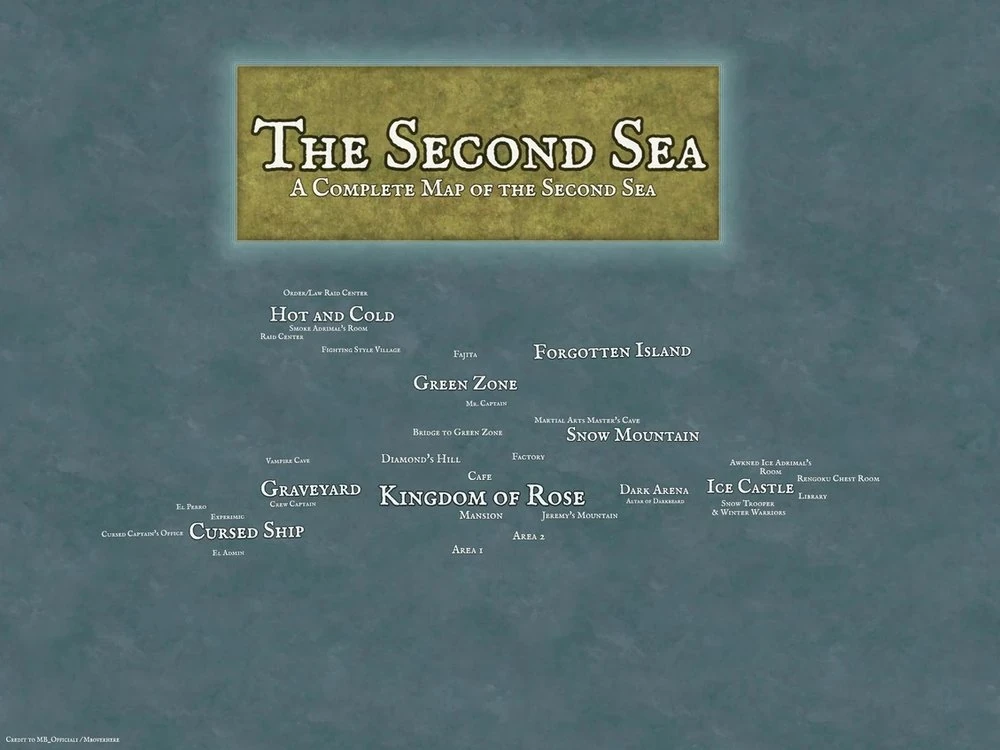
Second Sea is where the map starts punishing sloppy route choices. The islands are larger, the enemies hit harder, and some locations matter more as systems hubs than grind spots.
Second Sea Quick-reference Table
The current Second Sea page places the sea at 700-1500, lists the main islands, and notes that players spawn at the Kingdom of Rose after finishing the unlock.
The community leveling route also shows that some stops are strong for progression, while others are better treated as optional or short visits.
Main Leveling Islands
| Island | Typical entry/use range |
| Kingdom of Rose | 700+ |
| Green Zone | Roughly 875-950 |
| Graveyard | Roughly 950+ |
| Snow Mountain | Roughly 1000+ |
| Hot and Cold | Roughly 1100-1250 |
| Cursed Ship | Mid-late Second Sea |
| Ice Castle | Roughly 1350+ |
| Forgotten Island | Roughly 1425+ |
Side Locations And Hubs That Matter
| Location | Why it matters |
| Café | Important social and utility hub |
| Dark Arena | Special-purpose area, not core leveling |
| Remote Island | Side location, not part of your usual grind path |
| Cave Island / Indra Island | Niche or event-linked use, not core route |
Best Route Through Second Sea
The safest mental model is Kingdom of Rose → Green Zone / Graveyard → Snow Mountain → Hot and Cold → Cursed Ship → Ice Castle → Forgotten Island. That is more useful than treating every island like an equal mandatory grind time. The current leveling route even recommends minimizing or skipping certain stops depending on build efficiency.
Editor’s Route Note
I treat the Kingdom of Rose as both a progression stop and a systems hub. It is where Second Sea starts, but it is also where a lot of player confusion starts, because the island is useful for more than one reason.
Where Players Usually Waste Time In Second Sea
Two traps show up constantly. The first is overcommitting to islands that are technically available but inefficient for grinding.
The second is mistaking Café or Dark Arena for the next leveling stop when they are better understood as important side spaces.
The leveling guide explicitly calls out some islands as poor farming choices, which is exactly why a route-first article helps more than a giant island list.
Second Sea rewards players who think in terms of the best next stop, not complete map completionism.
How To Unlock The Third Sea At Level 1500
This is the unlock that most players overcomplicate because it includes more named steps. The good news is that the current access page lays it out cleanly once you stop treating it like a rumor chain.
The King Red Head And Rip_indra Path, Step By Step
According to the current Third Sea access page, the route is:
- Reach Level 1500.
- Make sure you have completed the Colosseum Quest.
- Go to the underground prison in Colosseum within the Kingdom of Rose and meet King Red Head.
- If needed, defeat Don Swan first.
- Re-open King Red Head’s cell by pressing the buttons in the correct order.
- Fight rip_indra until the cutscene triggers.
- Follow the prompt to Mr. Captain in the Green Zone.
- Talk to Mr. Captain to access the Third Sea.
What To Finish Before You Leave Second Sea
Use this checklist before you move:
- Confirm you are at Level 1500 or above.
- Make sure your Colosseum Quest is already done.
- Be ready to handle the Don Swan gate if King Red Head sends you there first.
- Know that Mr. Captain in Green Zone is the final step, not a random extra errand.
A Short Scenario: Arriving Underprepared In Third Sea
Jon clears the unlock at 1500 and expects the next sea to feel like a simple continuation of Second Sea. Instead, the spacing, enemy pressure, and travel demands hit much harder. That feeling is normal.
The Third Sea page itself notes that islands are spread farther apart, and later gains include portal-based travel options, which is part of why the sea feels bigger and less forgiving at first.
Once you understand that Third Sea is meant to stretch both your combat and your navigation, the unlock path feels less like a wall and more like a warning label.
Third Sea Island Order And Level Requirements
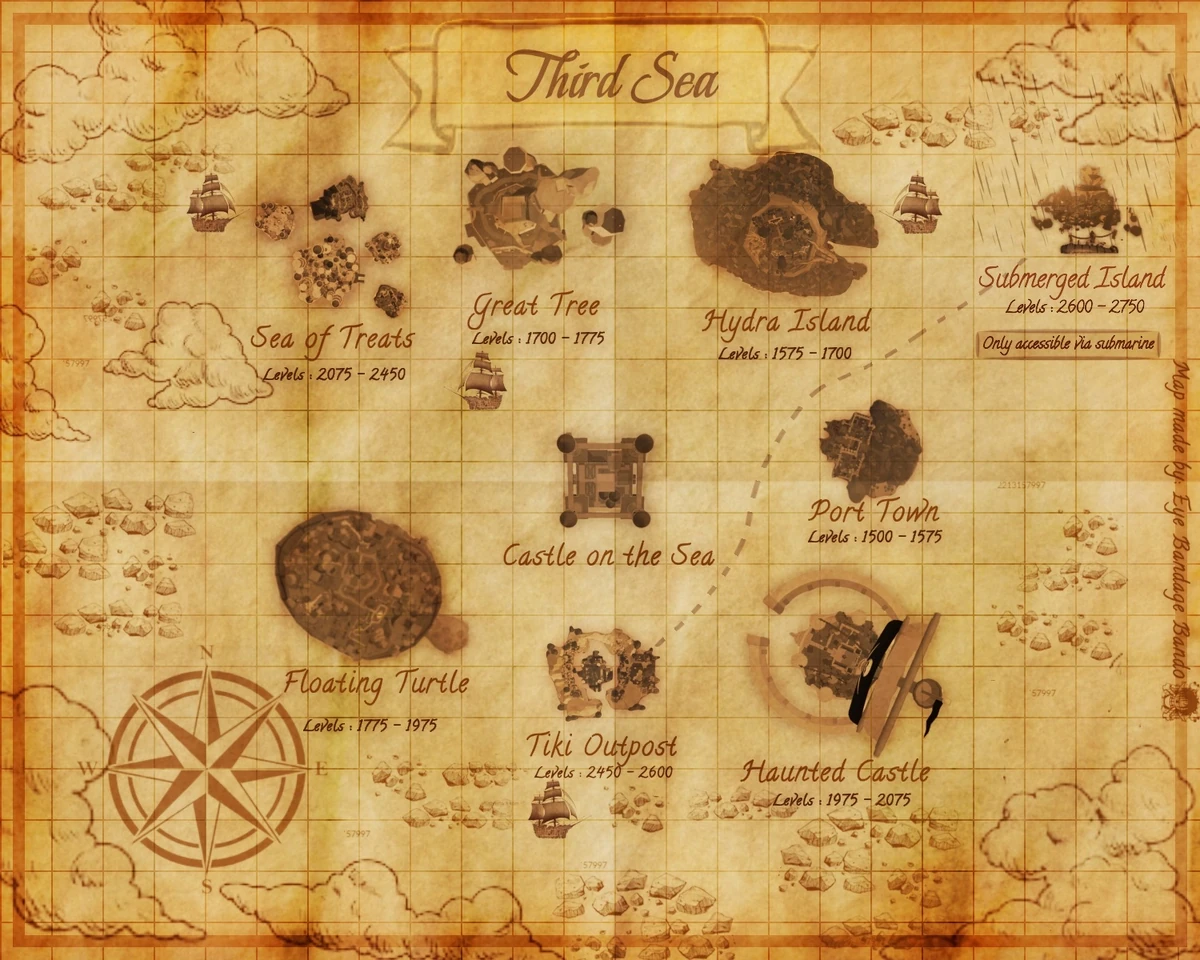
Third Sea is where a lot of articles turn messy, because they mix core progression islands with utility hubs and event-style islands.
This section keeps them separate so you can actually answer the only question that matters during a grind session: where should I go next?
Third Sea Quick-reference Table
The current Third Sea page lists the main islands as Port Town, Hydra Island, Great Tree, Floating Turtle, Haunted Castle, Sea of Treats, and Tiki Outpost, while separating Castle on the Sea and several special islands into another bucket. The leveling route also shows a practical order rather than a pure sightseeing order.
Main Leveling Islands
| Island | Typical entry/use range |
| Port Town | 1500+ |
| First Third Sea grind stop | About 1575+ |
| Great Tree | Mid Third Sea |
| Floating Turtle | Mid-late Third Sea |
| Haunted Castle | Late Third Sea |
| Sea of Treats | Late-endgame |
| Tiki Outpost | Very late game / current cap route |
Important Hubs And Confusing Endgame Locations
| Location | Why does it confuse players |
| Castle on the Sea | Essential hub, but not your first grinding stop |
| Submerged Island | Special-access location, not a standard route island |
| Kitsune Island / Mirage Island / Treasure Island / Frozen Dimension / Prehistoric Island | Special or event-style islands, not core leveling progression |
Best Route Through Third Sea
A strong route is Port Town → Hydra Island → Great Tree → Floating Turtle → Haunted Castle → Sea of Treats → Tiki Outpost. That follows the current main-island list and lines up with the broad late-game leveling path, even though some players adjust the exact stops based on fruit, mobility, and device performance.
Why Castle On The Sea, Floating Turtle, And Sea Of Treats Confuse Players
They confuse players for different reasons. Castle on the Sea looks like a destination that should be part of the main quest chain, but it works better as a central utility hub.
Floating Turtle is large enough that players can stay there because it feels like the center of the sea.
Sea of Treats is really several themed islands in one larger endgame zone, so it can feel like multiple progression stops smashed together.
The Third Sea page itself separates core islands from other islands, which is the exact distinction most players need.
The more clearly you separate the grind route from important locations, the less overwhelming Third Sea becomes.
First Sea Location Cheat Sheet
| Island | Where it is |
| Starter Island | Your starting point, depending on the Pirate or Marine team |
| Jungle | Northeast of Starter Island |
| Pirate Village | Northeast of the Jungle |
| Desert | East of Pirate Village |
| Middle Town | Directly opposite Starter Island |
| Frozen Village | North/center from Starter Island |
| Marine Fortress | North of Frozen Village |
| Skylands | Floating islands near the center of the sea |
| Prison | West of Frozen Village |
| Colosseum | East of Frozen Village |
| Magma Village | Floating island behind Marine Fortress |
| Underwater City | South of Frozen Village |
| Fountain City | Floating island behind the Colosseum |
These direction cues match the current direction-style coverage used by Beebom’s First Sea breakdown.
Second Sea Location Cheat Sheet
| Island / Location | Where it is |
| Kingdom of Rose | Starting island in Second Sea |
| Usoap’s Island | Behind the Kingdom of Rose |
| Café | Inside the Kingdom of Rose |
| Don Swan’s Mansion | Inside the Kingdom of Rose |
| Green Zone | Northwest of the Kingdom of Rose |
| Graveyard | West of the Kingdom of Rose |
| Snow Mountain | North of the Kingdom of Rose |
| Hot and Cold | North of Graveyard Island |
| Cursed Ship | Next to Graveyard Island |
| Ice Castle | North of Dark Arena |
| Forgotten Island | North of Green Zone |
| Dark Arena | Northeast of the Kingdom of Rose |
These are the kind of short, practical direction notes competitors include, and they make your locations promise much more credibility.
Third Sea Location Cheat Sheet
| Island / Location | Where it is |
| Port Town | Starting island in Third Sea |
| Hydra Island | Northeast of Port Town |
| Great Tree | West of Hydra Island |
| Floating Turtle | North of the western Great Tree |
| Castle on the Sea | Northwest of Port Town |
| Haunted Castle | Northwest of Castle on the Sea |
| Sea of Treats | Northeast of the Great Tree |
| Tiki Outpost | North of Castle on the Sea |
Map Shortcuts, Travel Tips, And Where Should I Go Next? Rules
Best Leveling Guide For First Sea! | BloxFruits (Update 27)
A good route is only half the story. The rest is knowing when to move, when to stay, and how to stop the map from wasting your time.
Using The Compass, Boats, Teleporters, And Movement Fruits
The Blox Fruits map reference notes that the game includes a built-in compass system, which helps point you toward the next island or quest objective.
In the Third Sea, the sea page also notes later portal-based travel linking places such as Hydra Island, Turtle Mansion, Castle on the Sea, and, after a later unlock, Tiki Outpost. That means navigation becomes a progression system of its own.
When To Stay Longer In A Sea Instead Of Rushing Ahead
If the next sea feels miserable on arrival, that is your signal. Unlocked only means you can enter, not that the grind will be smooth.
The community leveling route even suggests farming slightly past the raw unlock point in some cases, because the earliest mobs in the next sea may be technically available but still inefficient for your build.
One-page Checklist: Where You Should Be At Your Current Level
- 1-150:First Sea early route
- 150-625:First Sea mid-route islands
- 625-700+:Fountain City and Second Sea prep
- 700-1100:Early Second Sea
- 1100-1500:Late Second Sea and Third Sea prep
- 1500-2000+: Early to mid Third Sea
- 2000+ to late cap:Late Third Sea zones such as Haunted Castle, Sea of Treats, and Tiki Outpost
Wrong Island?
If your quests feel slow, enemies feel too tanky, or the travel time between kills is annoying, you are probably not on the best island for your build. Step back one stop, finish a few efficient levels, then return stronger.
Continue Reading: Blox Fruits Tier List For Grinding, Raids, And PvP
Frequently Asked Questions
What Is The Order Of Islands In Blox Fruits?
The overall order is First Sea, then Second Sea at Level 700, then Third Sea at Level 1500, with islands inside each sea generally following level-based progression.
How Many Seas Are In Blox Fruits?
There are three seas: First Sea, Second Sea, and Third Sea.
What Level Unlocks The Second Sea?
The Second Sea unlocks at Level 700 after the Military Detective, Ice Admiral, and Experienced Captain sequence.
What Level Unlocks The Third Sea?
The Third Sea unlocks at Level 1500 after the Colosseum, King Red Head, rip_indra, and Mr. Captain progression steps.
What Is The Order Of The Islands In First Sea?
A practical First Sea route is the starter island, Jungle, Pirate Village, Desert, Frozen Village, Marine Fortress, Skylands, Prison, Colosseum, Magma Village, Underwater City, and Fountain City.
What Is The Order Of Islands In Second Sea?
A practical Second Sea route is the Kingdom of Rose, Green Zone, Graveyard, Snow Mountain, Hot and Cold, Cursed Ship, Ice Castle, and Forgotten Island.
What Is The Order Of Islands In The Third Sea?
A practical Third Sea route is Port Town, Hydra Island, Great Tree, Floating Turtle, Haunted Castle, Sea of Treats, and Tiki Outpost, while Castle on the Sea is better treated as a hub.
Which Island Should I Go To Next In Blox Fruits?
Go to the highest island that still gives you efficient quest XP and manageable enemy pressure, not simply the next name on the full map list.
Do All Islands Have Level Requirements?
Most main-route islands do, but some locations act more like hubs, side areas, or special-event spaces than core leveling stops.
Are Café And Castle On The Sea Part Of The Main Leveling Route?
They matter a lot, but they are better understood as important hubs than as your main grinding islands.
Conclusion
You do not need to memorize every island to use the Blox Fruits map well. You need three things: the sea order, the unlock levels, and the habit of asking whether a location is a main route stop or just an important side hub.
That is the whole thesis in one line: First Sea teaches the route, Second Sea tests the route, and Third Sea punishes ignoring the route. If you remember that, you will waste less time, level more smoothly, and stop treating the map like a wall of names.
Bookmark this page for your next sea transition, because the best map is the one that tells you where to go next without making you guess.
Jump to
Blox Fruits Islands Locations And Level Requirements
How The Blox Fruits Map Is Structured
First Sea Island Order And Level Requirements
How To Unlock The Second Sea At Level 700
Second Sea Island Order And Level Requirements
How To Unlock The Third Sea At Level 1500
Third Sea Island Order And Level Requirements
First Sea Location Cheat Sheet
Second Sea Location Cheat Sheet
Third Sea Location Cheat Sheet
Map Shortcuts, Travel Tips, And Where Should I Go Next? Rules
Frequently Asked Questions
Conclusion
Latest Articles
Popular Articles